

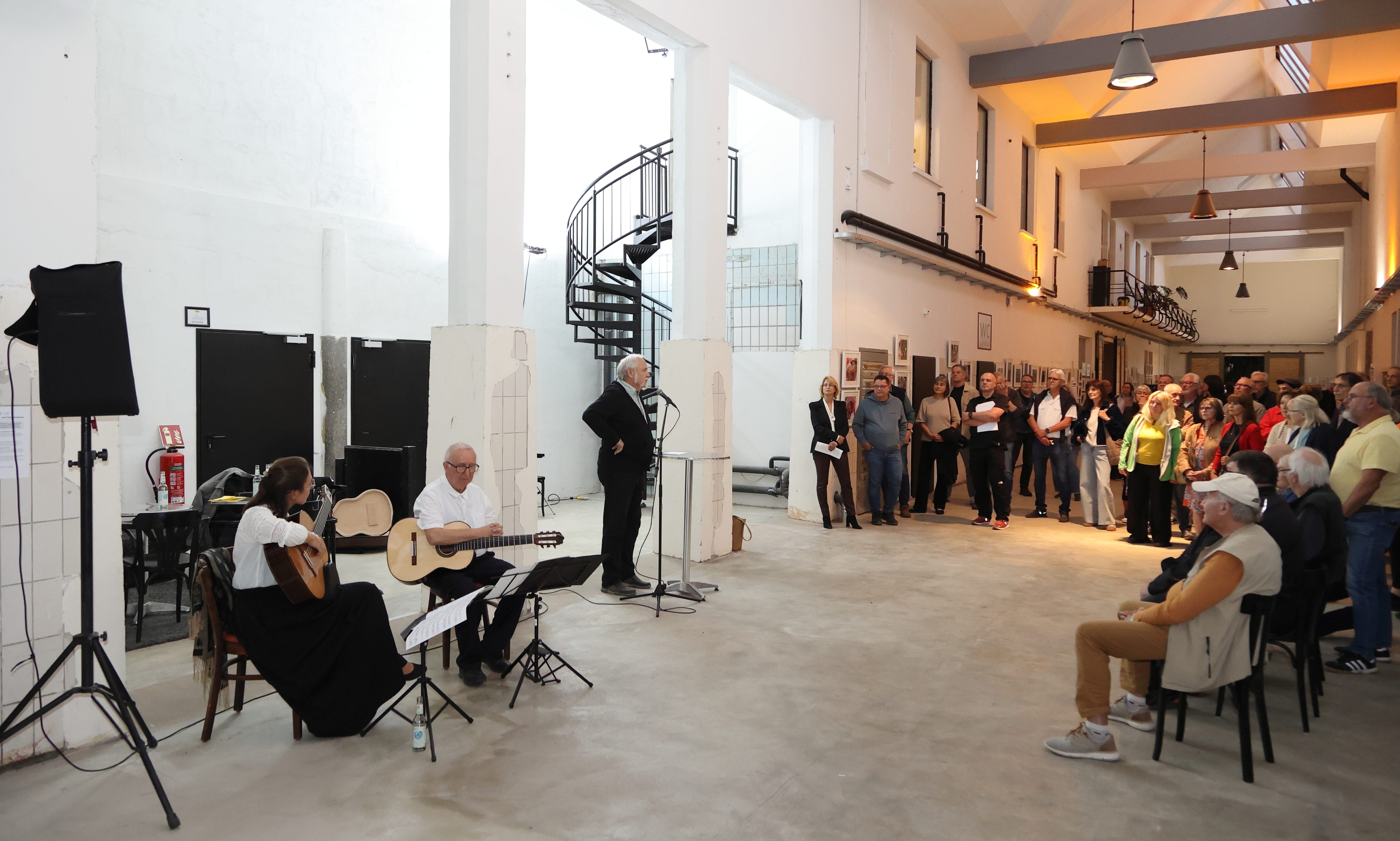
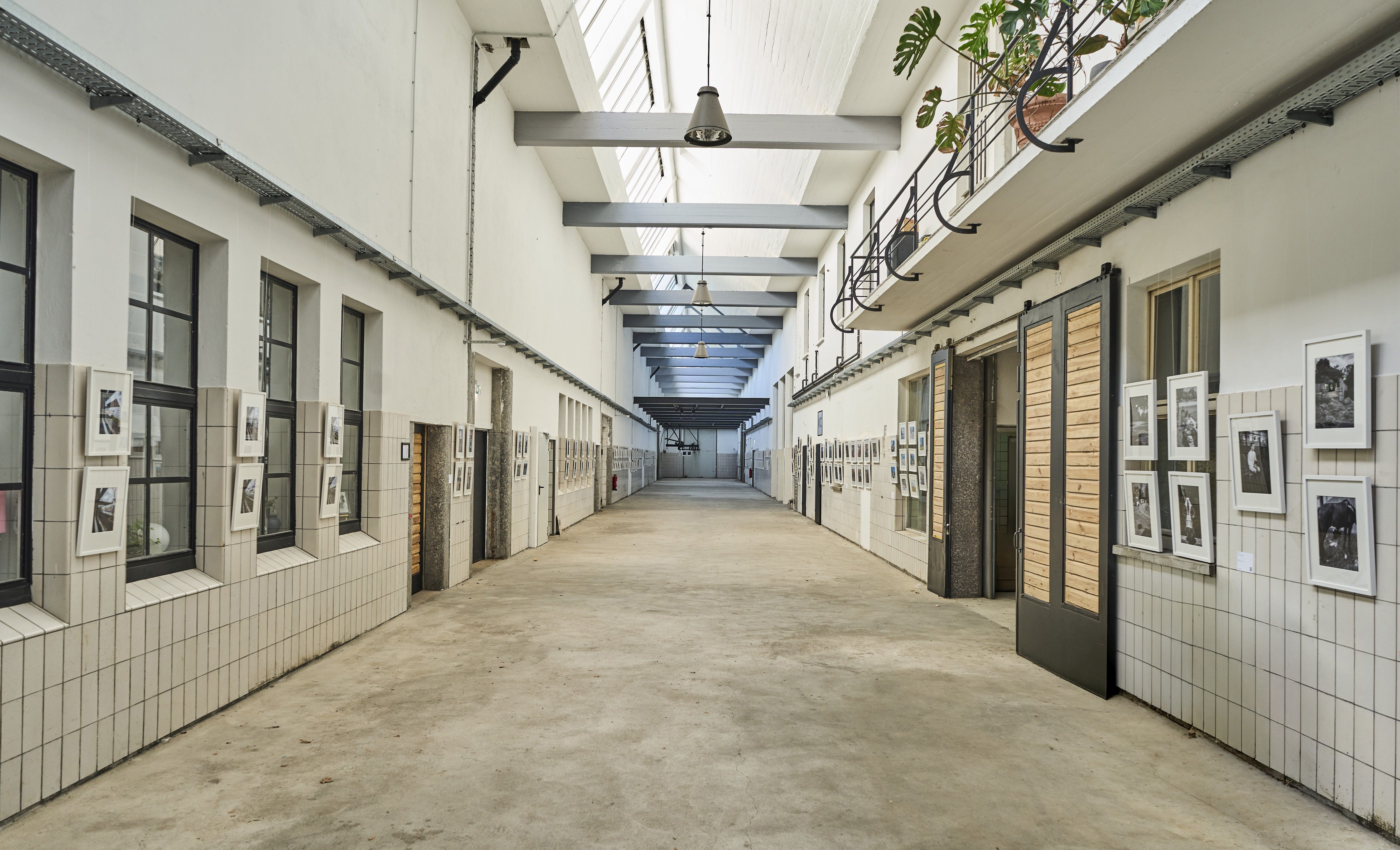
This year’s PFotoherbst got off to a flying start with a wonderful, well-attended opening and offers a very broad spectrum of what one might expect in the field of serial travel and reportage photography. There were international entries and themes from all over the world. The exhibition can still be viewed until 24 October 26 at the Alter Schlachthof in Pforzheim (Kleiststr. 2).
During the preliminary judging – in which, I’m sure, some series were inevitably excluded that would have been well worth showing – and during the preparations for framing, but above all whilst hanging the series, I had ample time to engage in detail with the thematic and formal aspects of the series on display. I had actually intended to pay detailed tribute to all the series in my introductory speech at the opening, but I quickly realised that this would not be possible. So I had to limit myself to one or two sentences per series, which I will reproduce here. The aim is to provide an overview, to showcase the diversity of the exhibition, and to offer the opportunity to find out more about what else the exhibiting travellers, documentary filmmakers and artists have to offer.
A systematic look at the exhibited series reveals that they seek to introduce us to a wide variety of subjects.
Firstly, there are the travel photographs:
In his conceptual series ‘RE 7’, Christoph Eberle shows us all the stops on the regional express train between Offenburg and Freiburg, captured through the train window.
In her series ‘Edge of the Desert’, Sabine Gassner shows us the deserted yet man-made landscapes on the edge of the desert.
In her series “Lost in Snow and Ice”, Birgit Hantke takes us to the Lofoten and Vesterålen islands, where she depicts typical houses set against a snow-covered landscape.
Stefan Henning travelled from the Atlantic to the Mediterranean with his pinhole camera and took photographs for us at various locations along the French-Spanish border.
Ben Umbeer, who has roots in Schömberg, shows us in his series ‘A Portrait of Mogador Harbour’ views of the harbour in Essaouira, Morocco, featuring the people staying there.
Then there are series that focus specifically on particular events:
In his series ‘Augenblicke’, Alexander Friedrich Beck shows us impressions of the Día de los Muertos in Mexico.
Lothar Zull transports us to the colourful world of the Cardiff Pride Parade in Wales.
There are also series that reveal traces of history or places that will soon be consigned to history:
For example, the ‘Valley of the Paper Mills’ on Lake Garda. Margrit Groh seeks to bring this open-air museum of industrial archaeology to life for us in her atmospheric black-and-white series.
In ‘Malmberget’, Uwe Handke uses calm, subdued colours to depict a Swedish village on the Arctic Circle that is set to make way for iron ore mining.
In his moving black-and-white series ‘Kinds auf Remembrance’, Dietmar Lehne captures days of remembrance and places commemorating the First World War in England.
At this point, it is perhaps also worth mentioning the series ‘Gernika 1937 – my mother’s nightmare’ by Aitor Arana. As the series contains photomontages, it is not entered into the competition, but it is so important that we have decided to exhibit it nonetheless. It serves as a reminder of why Pforzheim and Gernika are twin towns, and urges us never to allow such a thing to happen again.


Then there is a whole series of photo series that I would describe as social documentaries:
In his series ‘Auf der grünen Wiese Bergedorf West’, Peter Czikowski takes us, in a very unspectacular way, into a prefabricated housing estate and captures it and its residents in snapshots.
In his series “Horse with no Name”, Torsten Dodillet presents unhurried images of a dressage competition in Ludwigsburg through beautiful black-and-white photographs.
Sandra Hoyn, who has already won the Fotoherbst competition twice, presents orangutans boxing and posing in human clothing in her series “Gefangen für unsere Unterhaltung” (“Captured for Our Entertainment”), thereby denouncing wildlife tourism in Thailand.
Paul Schumacher’s series is almost trivial, yet very well photographed. It is entitled ‘Our society is strongly shaped by the ubiquity of the smartphone’ and illustrates precisely this.
This category also includes series that bring activities or processes to life, showcasing craftsmanship or arts and crafts:
Peter Bihr from Switzerland documents the cultivation and processing of forest coffee in Ethiopia.
Anna Eickhoff from Pforzheim brings together craftspeople and their work in her series. Portraits of the people alternate with images of their hands.
Manfred Schroth shows, step by step, the creation of a brass figurine in East Africa. The final image shows the result of the process.
Bente Mara is Stachowske’s series ‘Women, Bees and the Forest’ features Black women learning beekeeping in theory and practice.
Finally, Oliver Wolff takes us along on the journeys of a doctor who visits people with blood-borne diseases using a mobile, bicycle-powered clinic to treat them.
A special kind of series is one that I would like to describe as a collection. Although they are more additive than narrative, they nevertheless tell a story indirectly:
for example, ‘Bel Ape’ by Anouchka Olschewski. She depicts the colourfully decorated Italian Piaggio three-wheeled delivery tricycles in a wide variety of everyday situations.
Werner Mansholt, who has taken part in every Fotoherbst competition since 2006, brings together in his series ‘Chapeau’ various sun hats that he collected during the unique, annual photography festival in Arles.
Finally, and particularly important in this day and age, are environmental themes:
Antonio Cunico, who won the City of Pforzheim’s special prize for participants from twin towns, depicts crowds of people in the Alps in his series ‘Mountain Park’.
In his series ‘Coffee Cultivation in Vietnam – In the Face of Climate Change’, Dario Ernst shows how the beans, which ripen in the shade of trees, are grown and processed.
Muhammad Amdat Hossein from Bangladesh, in his series ‘Living with the Flood’, depicts people living in a flood-prone area.
We remain in Bangladesh with Joy Saha’s series ‘Homes of Haor’. In almost abstract bird’s-eye-view images, he depicts settlements in the low-lying delta regions of Bangladesh, which are completely surrounded by water during the rainy season.
I hope my brief tour of the exhibition hasn’t bored you; perhaps it has even inspired you to take a look at the series. One opportunity to do so would be on 16–17 October at fotocamp Pforzheim (registration required). We’ll be at the Schlachthof; I’ll be there and, if required, will also be giving guided tours of the exhibition.
Alle the Pictures are taken by Ralf Sonnet
Translated with the help of DeepL.com (German version on photo-philosophy.net)
Eine wunderbare Beschreibung der individuellen Serien. Es wird sicherlich nicht einfach, die besten aus diesen so unterschiedlichen Serien auszuwählen. Es bleibt also spannend bis zum Schluss.